
Your Magnificence, Honorable Rector,
Dear Chairwoman of the Academic Senate,
Dear Chairman of the Board of Trustees,
Dear Secretary of State,
Ladies and gentlemen, dear audience,
first of all, I would like to convey to you the greetings of the rectors of universities and colleges and the entire Slovak Rectors' Conference on the occasion of the ceremonial opening of the academic year 2025/2026.
Universities have been a historical part of European civilization for centuries, they are still modern and developing "organisms". Even in the past, they underwent major or minor changes, they adapted to the demands of society, some principles of their functioning remained preserved, some were abandoned and others accepted. For several decades, we in Slovakia have been thinking about the future of our universities and higher education, their direction and mission.
Today, however, the speed of change is different, thanks to technological progress. In the end, the key to the "survival" of universities may be a completely different phenomenon - artificial intelligence. Today, machines can write essays, solve math problems, and conduct research. So what values will the universities offer to society? It seems that the future of universities in the coming years will depend on the answer to this question. As a doctor, I am not afraid of artificial intelligence, because artificial intelligence will not replace the doctor. However, it will replace the one who does not use it.
Freedom is currently also the most resonant principle from the Magna Charta Universitatum, which accompanies universities and is their characteristic feature. Interesting ideas about freedom can be found in the book of conversations between the Czech philosopher Ján Sokol and Josef Beránek, Bravery for Freedom from 2021, where he tries to bring readers closer to the academic freedom of an individual - a member of the academic community. Ján Sokol talks about the university as an exceptional institution where an academic can "be his own master within certain rules".
Another view at the institutional academic freedom - i.e. the autonomy of universities, was proposed by Professor Juraj Švec, rector of the Comenius University in Bratislava, who in 1996, while defending universities during the amendment of the Act on Universities, emphasized, among other things, that "the autonomy of universities is not their prerogative, but a condition for the successful fulfillment of their mission in the service of the public and in the preparation of a professionally competent, but also cultured and tolerant young generation of national intellectuals."
The European Association of Universities also formulated its view on academic freedom in 2025 as principles and guidelines for their protection. These focus on the idea that academic freedom is a right as well as a responsibility of individuals and academic communities.
The new academic year, which we are now entering, is different for each of us. We have our own expectations, but also obligations and conditions.
Dear ladies and gentlemen,
I wish you and your Comenius University in Bratislava a successful new academic year, filled with meaningful work, but also with new knowledge, inspirations and discoveries. May we succeed together in finding answers to the difficult questions we face in order to strengthen the position of the university as an institution that is our Alma Mater.
Viva academia!
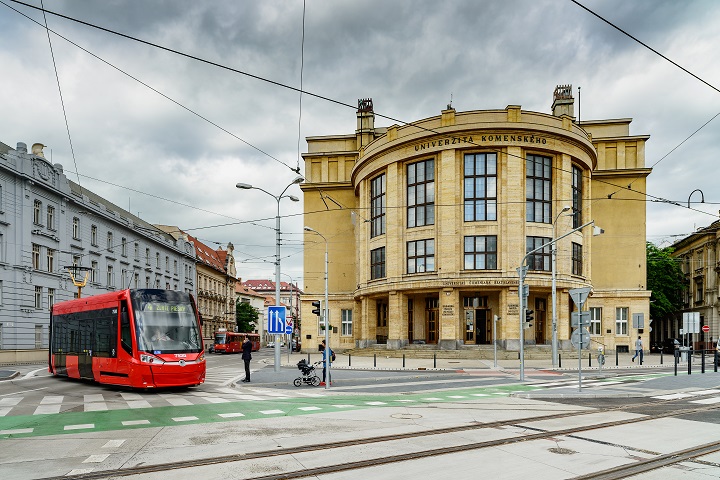
Photo by CU